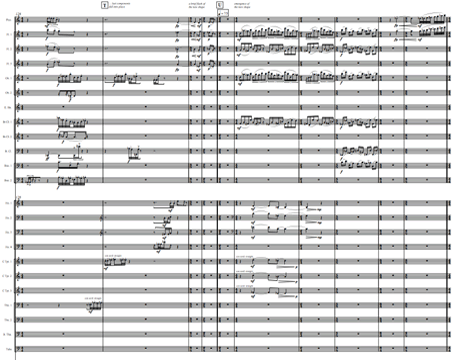
click to enlarge
Wu Xing/Water for orchestra (2013) Commissioned by Radio France / Festival Présences 2014
Instrumentation
4 Flutes (I + II doubling piccolo) 2 Oboes
1 English Horn
2 Clarinets in Bb
1 Bass Clarinet in Bb 2 Bassoons
4 Horns in F
3 Trumpets in C with straight, cup, plunger and harmon mutes
2 Trombones (Tenor) with straight, cup, plunger and harmon mutes 1 Trombone (Bass) with straight, cup, plunger and harmon mutes
1 Tuba with straight mute
Percussion (three players)
3 suspended cymbals (small, medium, large) 1 Snare drum
1 Bass Drum on ring stand
1 small sized Triangle
1 large Tam-Tam
1 set of Orchestral Chimes (tubular bells) 1 set of Crotales:
1 Glockenspiel
1 Vibraphone (with functioning motor) 1 Marimba
1 Harp
1 Grand piano (doubling Celesta) 1 MIDI-Keyboard *
Violins 1 (stand I,II) Violins 2 (stand I,II) Violins 3 (stand I,II) Violins 4 (stand I,II)
Violas 1 (stand I,II) Violas 2 (stand I,II)
Cellos 1 (stand I,II) Cellos 2 (stand I,II)
Contra basses 1 (stand I,II) Contra basses 2 (stand I,II)
program note
In Chinese cosmology, the five elements or five «phases» (wu xing 五行) represent an intricate process of interwoven forces. While the material identity of each of these elements is largely metaphorical, their function as agents and carriers of energy, energy transfer, creation and destruction is concrete and complex. Together, they form a cycle, a rhythmic and highly dynamic interplay of heterogenous and yet complementary forces.
For the Chinese, human health, human psyche and personality, the time of human birth, procreation and death are all as much subject to wu xing, as are the seasons of the year, the circulation of weather patterns and the processes and patterns of nature.
In my «WuXing»-cycle of five works for orchestra each piece is consecrated to one of these elements. WuXing/Water is the third piece in the series after WuXing/Metal (2006-2011) commissioned by the SWR and WuXing/Fire (2010) commissioned by Philharmonic Orchestra of Cottbus. The five pieces in this cycle are not program music, but rather take the concept of wu xing as a dynamic model, which determines much of the overall design of my cycle, such as the relationship of the pieces to one another and the order of their succession. Wu xing also impact the character design and choice of material for each of the individual compositions. For each piece I try to charge my musical objects as much as possible with musical attributes corresponding to the characteristcs of the five individual agents of wu xing. This compositional strategy perhaps is driven by my fundamental interest in the associative and communicative qualities of music as such, and all forms of musical organisation and design.
The cultural connotations of Water are rich, ranging from the magical and auratic to the nourishing, from the seductive or sensual to the purifying and threatening.Water in the wu xing system denotes on the one hand a conserving, downward motion bound for stillness, even death and is the carrier of anxiety and fear. On the other hand, water stands for intelligence, suppleness and insurmountable perseverance. It is agile and a dazzling shape-shifter. A still surface of water reflects what is outside, while concealing what lies underneath. Change perspective and it becomes visible.
français
composition : 2013-2014 | commande de Radio France | création : le 13 février 2014 à Radio France par l’Orchestre National de France dirigé par Ilan Volkov | 20 mn environ
Dans la cosmologie chinoise, les cinq éléments ou cinq « phases » (wu xing 五行) représentent un processus de forces étroitement tissées. Alors que l’identité matérielle de chacun de ces éléments est en grande partie métaphorique, leur fonction d’agent et de vecteur d’énergie, de création et de destruction, est réel et complexe. Ensemble, ils forment un cycle, un jeu rythmique et hautement dynamique de forces hétérogènes et cependant complémentaires.
Pour les Chinois, la santé humaine, la psyché humaine et la personnalité, le temps de la naissance, de la procréation et de la mort sont tous assujettis au wu xing, comme le sont les saisons, la circulation des eaux et les desseins de la nature.
Dans WuXing, mon cycle de cinq oeuvres pour orchestre, chaque volet est consacré à l’un de ces éléments. WuXing / Water est le troisième de la série après WuXing / Metal (2006-2011), commande de la SWR, et WuXing / Fire (2010), commande de l’Orchestre Philharmonique de Cottbus. Il ne s’agissait pas là d’écrire de la musique à programme, mais plutôt d’envisager le concept de Wu xing comme un modèle dynamique, qui détermine plus que tout la forme de mon cycle, la relation entre les différentes pièces et leur succession. Wu xing touche également la personnalité de chaque composition et le choix du matériel qu’elle utilise.
Pour chacune d’entre elles, j’ai essayé de lester mes objets musicaux des caractéristiques des cinq agents individuels du wu xing. Cette stratégie de composition est peut-être également déterminée par l’intérêt que je porte aux qualités en soi de la musique et à toutes les possibilités d’organisation et de forme.
Les connotations culturelles de Water sont riches et procèdent de la magie, de la nourriture, de la séduction et de la sensualité jusqu’à la pureté et la menace. Water, dans le système WuXing, tend d’une part vers la tranquillité, quand bien même elle passerait par la mort, l’anxiété et la peur ; d’autre part, l’eau signifie l’intelligence, la souplesse et l’infatigable persévérance. Elle change de forme avec agilité et d’une manière éblouissante. La surface d’une étendue d’eau reflète ce qu’il y a à l’extérieur et le relie à ce qui se trouve au-dessous. Il suffit de changer de perspective pour que tout devienne visible.